
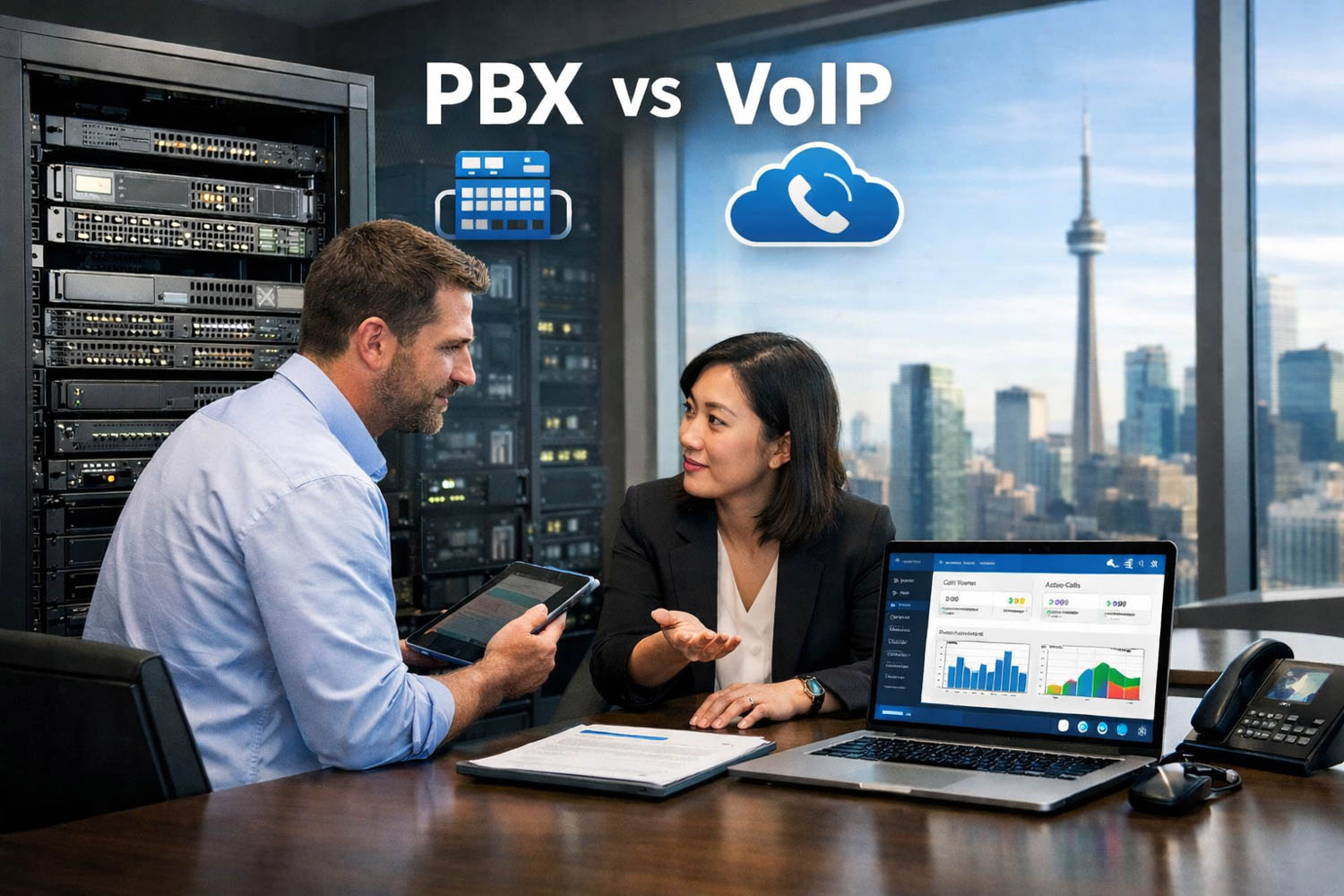
When evaluating communication infrastructure, the decision between PBX vs VoIP is more than a technical comparison — it’s a strategic business choice. The right solution influences operational efficiency, customer experience, scalability, and long-term cost management. For organizations across Toronto and the surrounding region, selecting the appropriate platform requires careful planning and expert guidance.
As a provider of enterprise-grade technology solutions, we work closely with small, mid-sized, and large organizations to assess their operational needs and design communication environments that support both immediate performance and future growth.
What is a PBX System?
A PBX system (Private Branch Exchange) is a traditional, on-site communication infrastructure that connects internal extensions through centralized hardware. While it has evolved over time, its foundation remains rooted in physical equipment installed within your premises.
Organizations that choose this model typically value:
- Full infrastructure control – Hardware is managed internally, offering direct oversight.
- Consistent call performance – Less dependent on internet stability.
- Custom configuration – Advanced routing, extensions, and call management features.
- Enhanced internal security management – Particularly appealing to regulated industries.
When evaluating PBX phone system benefits, many leadership teams appreciate the reliability and control this model provides. For organizations with dedicated IT departments and stable office-based teams, this can be a dependable long-term investment.
However, it requires ongoing maintenance, hardware upgrades, and internal oversight — factors that must be considered in total cost planning.
What is VoIP?
VoIP (Voice over Internet Protocol) delivers voice communication through internet connectivity rather than traditional wiring. This cloud-based approach has become increasingly popular due to its flexibility and cost structure.
Organizations adopting this model benefit from:
- Rapid scalability – Add or remove users without hardware expansion.
- Remote workforce support – Employees can connect from virtually anywhere.
- Lower upfront investment – No major on-site infrastructure required.
- Continuous feature updates – Enhancements managed by the service provider.
- Integrated collaboration tools – Messaging, video conferencing, analytics, and CRM connectivity.
For companies exploring cloud phone systems for business, this approach offers agility and predictable operational expenses. It is particularly well-suited for hybrid teams and organizations anticipating rapid growth.
That said, internet reliability, bandwidth capacity, and security configurations must be evaluated carefully before implementation.
Which Phone System is Best for Small Businesses in Toronto
Smaller organizations often require communication platforms that balance functionality, flexibility, and financial efficiency. The best choice depends heavily on operational structure and growth plans.
When advising smaller teams, we focus on:
- Ease of deployment – Minimal disruption during setup.
- Cost predictability – Subscription-based models that align with budget planning.
- Mobility and flexibility – Supporting remote or mobile staff.
- Integration capabilities – Connecting seamlessly with CRM and productivity tools.
- Room for growth – Ensuring the system won’t need replacement within a few years.
Providers specializing in small business phone systems should prioritize scalability without unnecessary complexity. For many growing companies, cloud-based platforms provide the agility needed to compete effectively without heavy infrastructure investment.
PBX vs VoIP for Medium & Large Enterprises
As organizations expand, communication needs become more complex. Higher call volumes, multiple departments, compliance requirements, and multi-location coordination all influence the decision-making process.
When guiding larger organizations, we assess:
- Advanced call routing architecture
- Detailed analytics and reporting capabilities
- Integration with enterprise-level CRM and ERP platforms
- Redundancy and failover configurations
- Multi-location support under centralized management
- Long-term scalability aligned with growth projections
Implementing strong enterprise communication solutions ensures that infrastructure supports operational efficiency at scale. Larger organizations often require a more tailored evaluation, weighing control and customization against flexibility and remote accessibility.
Strategic planning at this level prevents future bottlenecks and costly system replacements.
Cost-effective VoIP Solutions for Toronto Companies
Cost remains a major consideration for leadership teams evaluating modernization. However, a true cost analysis extends beyond upfront pricing.
Cloud-based platforms can deliver meaningful financial advantages when structured correctly. Key considerations include:
- Eliminating large capital expenditures
- Reducing maintenance and hardware upgrade costs
- Shifting to predictable monthly operational expenses
- Minimizing internal IT resource strain
- Supporting distributed teams without additional infrastructure
Organizations exploring VoIP solutions for companies often find that subscription-based models improve cash flow predictability while maintaining enterprise-grade capabilities.
That said, cost efficiency should never compromise performance, security, or reliability. A proper evaluation ensures savings do not introduce operational risk.
Comparing Options: Key Takeaways
Selecting the most suitable communication infrastructure for your company requires aligning technology with business strategy. We guide organizations through a structured evaluation process focused on measurable outcomes.
Infrastructure & Implementation
- Does your organization prefer on-site control or managed cloud services?
- Do you have internal IT capacity for ongoing maintenance?
- How quickly must the system be deployed?
- Will expansion require physical upgrades?
Scalability & Future Planning
- Can the platform support multi-location growth?
- How easily can users be added or removed?
- Will the system remain viable over the next 3–5 years?
Financial Strategy
- Capital investment vs. operating expense model
- Long-term maintenance and support costs
- Hardware replacement cycles
- Licensing and subscription scalability
Reliability & Continuity
- Built-in redundancy and failover features
- Disaster recovery protocols
- Service-level guarantees
- Downtime risk mitigation
Security & Compliance
- Encryption standards
- Access controls and administrative oversight
- Industry-specific regulatory alignment
A comprehensive VoIP vs PBX comparison should evaluate not just technical features, but how the solution supports productivity, customer satisfaction, and long-term growth objectives.
Great question — and strategically, it should replace it, not sit as a separate section.
Here’s why:
- Both sections serve the same purpose (establishing authority + encouraging action).
- Keeping them separate creates redundancy.
- Combining them strengthens the message and improves flow.
- It avoids sounding repetitive while increasing conversion impact.
Partnering with Local Providers
Technology decisions should never be made in isolation. Working with experienced providers offering business phone systems Toronto organizations trust ensures your communication infrastructure aligns with both immediate operational needs and long-term growth objectives.
As a consultative partner serving companies across the region, we go beyond installation. When you work with us, you can expect:
- Personalized consultation – We assess your current environment, challenges, and future goals.
- Tailored infrastructure recommendations – Strategic, unbiased guidance aligned with your organization.
- Seamless migration planning – Smooth deployment with minimal disruption to daily operations.
- Ongoing optimization and support – Continued assistance to maintain performance and scalability.
- Strategic technology roadmapping – Infrastructure designed to evolve as your organization grows.
Reliable Toronto business telecom services should function as a strategic asset — not just a utility. With the right partner, your communication environment becomes a foundation for productivity, collaboration, and sustained success.
Conclusion
Selecting the right communication infrastructure is a strategic decision that impacts efficiency, collaboration, customer experience, and long-term scalability. Smaller organizations often prioritize flexibility and predictable costs, while larger enterprises require advanced routing, analytics, and resilient continuity planning.
There is no one-size-fits-all solution. The right choice depends on your operational structure, growth plans, security requirements, and internal resources. Taking the time to evaluate these factors carefully ensures your investment supports performance today and adaptability tomorrow.
If your current system no longer aligns with your objectives — or if you’re planning for growth — this is the right time to reassess your options. Making an informed decision now positions your organization for stronger operational stability and sustained success. Ultimately, understanding PBX vs VoIP is the first step toward building a communication environment that truly works for your company.
Ready to Evaluate Your Communication Strategy?
If you’re considering an upgrade or simply want clarity on your options, our team is here to help. Schedule a consultation to assess your current setup and receive tailored recommendations aligned with your operational goals.
Book your consultation today and take the next step toward a more efficient, scalable communication environment.