
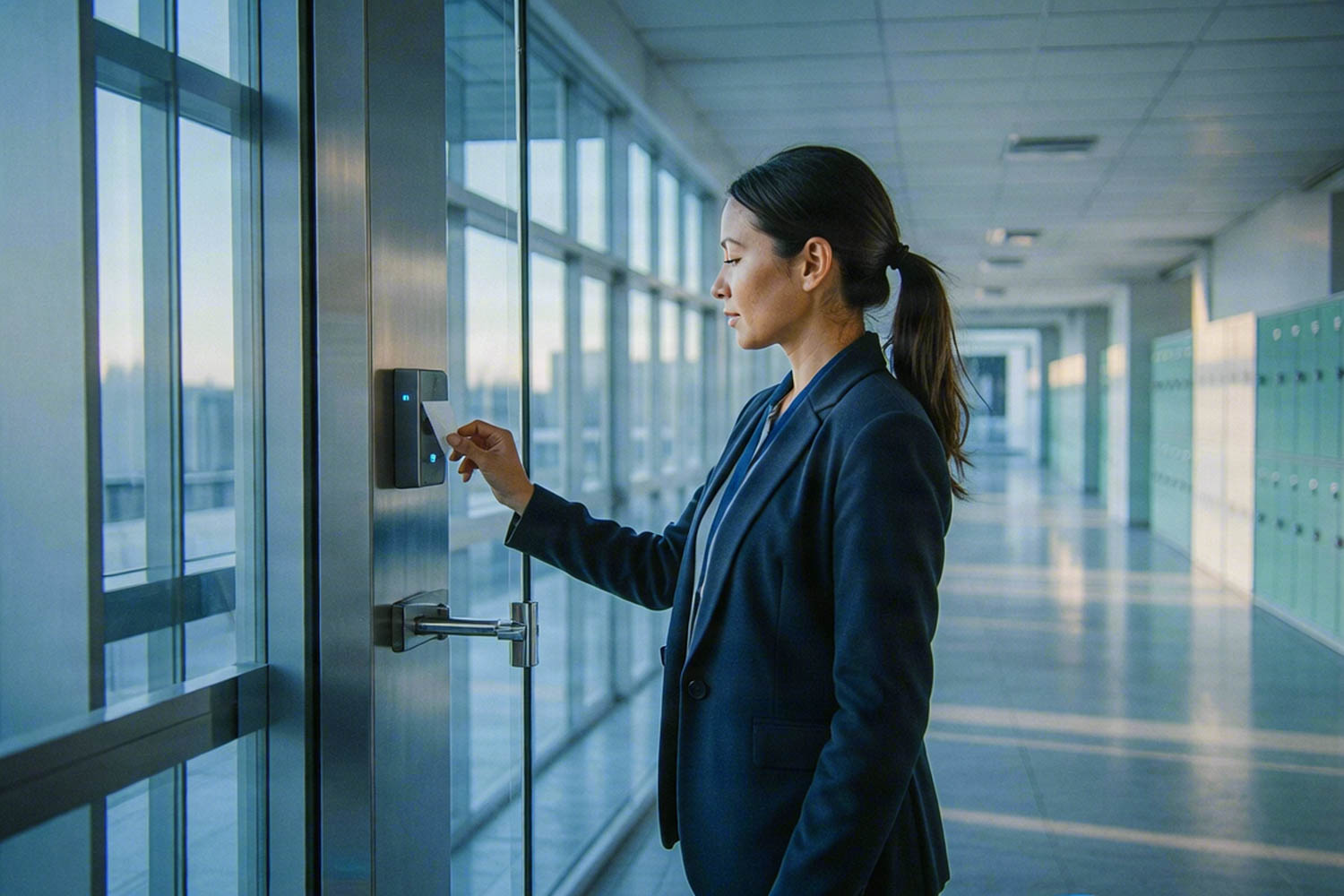
For schools evaluating school access control solutions, the goal is no longer simply to keep unauthorized people out. Modern access management is about creating a safer, more connected environment while giving administrators greater control over who can enter specific areas, when they can enter, and how access is managed across the facility.
For schools and educational organizations throughout Toronto and the GTA, this can be a significant undertaking. A typical facility may have multiple entrances, classrooms, administrative offices, gyms, laboratories, shared spaces, and areas used by contractors or community organizations. Each location can have different access requirements.
Modernizing entry infrastructure therefore requires careful planning. The right approach should balance security, convenience, scalability, and the school’s existing technology infrastructure.
Why Schools Are Moving Beyond Traditional Keys
Traditional keys can create several challenges for administrators. Keys can be misplaced, copied, shared between individuals, or remain in circulation after an employee, contractor, or volunteer no longer needs access.
Electronic credentials offer a more flexible alternative. Instead of changing physical locks whenever access needs to change, administrators can modify permissions electronically.
Depending on the platform, authorized personnel may be able to:
- Assign access according to individual roles
- Restrict entry to specific buildings or rooms
- Establish schedules for when credentials work
- Disable lost or compromised credentials
- Review access activity
- Manage permissions across multiple facilities
This flexibility can make day-to-day administration easier while providing greater visibility into facility access.
For organizations managing several buildings, the difference can be particularly significant. Instead of relying on separate processes at each location, administrators can establish consistent policies and manage access through a centralized platform.
Assess the Building Before Choosing Technology
One of the most important steps in modernization is understanding how the facility is actually used.
Rather than starting with a specific product or reader, administrators should first examine the building’s access points, traffic patterns, and operational requirements.
Consider areas such as:
- Main and secondary entrances
- Staff-only doors
- Administrative offices
- Classrooms and specialized rooms
- Gymnasiums and auditoriums
- Storage and equipment areas
- Loading and delivery entrances
- Before- and after-school program areas
- Spaces used by outside organizations
Not every door requires the same level of protection. An administrative office containing sensitive records may require different permissions from a gym that is regularly used by community groups outside school hours.
A thoughtful school security systems strategy should therefore be based on the facility’s actual risks and requirements rather than applying the same configuration to every entrance.
Think About Who Needs Access
Schools have a constantly changing population of users. Teachers, administrators, maintenance personnel, IT staff, contractors, volunteers, students, and other authorized individuals may all require different levels of access.
A modern platform should make those differences easy to manage.
Administrators should look for capabilities such as:
- Role-based access permissions
- Time and schedule restrictions
- Temporary credentials
- Fast credential deactivation
- Detailed activity records
- Multi-building administration
- Support for future expansion
For example, a teacher may need access to classrooms during the school day, while facilities personnel may require access during evenings or weekends. A contractor could need temporary access to a particular area for only a few days.
The ability to adjust these permissions without replacing physical hardware can make access management considerably more efficient.
Don’t Forget Visitor Management
Students and employees are only part of the access picture. Schools also receive parents, guardians, vendors, delivery personnel, contractors, volunteers, and community members.
This is where visitor management systems can complement an overall entry strategy.
A well-planned visitor process can help staff establish a consistent procedure for registering and identifying guests while maintaining greater awareness of who is in the facility.
Depending on the technology selected, visitor management may include:
- Visitor registration
- Identification and credential verification
- Temporary access credentials
- Staff notifications
- Arrival and departure records
- Access restrictions based on visitor type
The objective is not to create unnecessary barriers for legitimate visitors. Instead, it is to establish a predictable process that improves visibility while allowing authorized guests to move through the facility efficiently.
Look Beyond the Door
Access control should not necessarily operate as an isolated technology.
Modern facilities increasingly depend on multiple connected systems, including video surveillance, intercoms, alarms, communications platforms, and network infrastructure. When these technologies are planned together, they can provide administrators with a more complete picture of activity throughout the building.
For example, an access event can potentially be correlated with video surveillance, helping authorized personnel understand what occurred at a particular entrance.
Integration also makes infrastructure planning more important. Readers, controllers, cameras, intercoms, and other connected devices depend on reliable network connectivity and appropriate cabling.
A modernization project should therefore consider the underlying infrastructure as part of the overall design—not as an afterthought.
Is Cloud-Based Access Control Right for Your School?
Cloud-based access control has become an option for organizations that want centralized administration and easier management across multiple locations.
For a school board or organization with several facilities, cloud-based platforms can provide a convenient way to administer credentials and policies from a centralized environment. Some platforms may also support mobile credentials and remote administration.
However, cloud deployment is not automatically the right choice for every facility.
Administrators should evaluate:
- Internet reliability
- Existing network infrastructure
- Data protection and privacy requirements
- Vendor support
- System availability and backup capabilities
- Integration with existing technology
- Long-term operating costs
The important consideration is not whether a solution is cloud-based or locally managed. It is whether the architecture reliably supports the school’s operational and security requirements.
Plan for Emergencies and Future Growth
Access management should also be evaluated in the context of emergency procedures.
Administrators and their technology partners should understand how controlled doors behave during power interruptions, emergency situations, evacuations, and other circumstances where normal access procedures may change.
Life-safety requirements, applicable codes, and emergency procedures should always be incorporated into the design with qualified professionals.
Future growth should receive the same attention.
A solution that works for one building today may eventually need to accommodate additional facilities, users, doors, technologies, or administrative requirements. Selecting scalable infrastructure can help prevent another major modernization project when the organization expands.
This is particularly relevant for larger educational organizations. Technology investments should ideally support both today’s needs and tomorrow’s operational requirements.
Infrastructure Matters More Than You Think
Even the most sophisticated access platform depends on reliable physical infrastructure.
Electronic readers, door controllers, cameras, intercoms, and other connected devices require appropriate cabling, connectivity, power, and network capacity. If the underlying infrastructure is outdated or poorly planned, the performance of the overall solution can suffer.
For this reason, administrators should consider access modernization alongside broader technology infrastructure.
A project may also present an opportunity to review:
- Voice and data cabling
- Fiber optic connectivity
- Network infrastructure
- VoIP communications
- PBX systems
- Equipment rooms and telecommunications spaces
Coordinating these technologies can create a more cohesive environment and make future upgrades easier to implement.
Choose a Solution That Can Scale
The best access strategy is not necessarily the one with the most features. It is the one that fits the facility, users, budget, and long-term operational goals.
Administrators should ask potential technology partners:
- Can the solution support additional buildings?
- How easily can new users and credentials be added?
- Can permissions be changed without replacing hardware?
- Can the platform integrate with existing infrastructure?
- What happens if network connectivity is interrupted?
- How will the system be supported after installation?
- Can the infrastructure accommodate future technologies?
Taking the time to answer these questions before implementation can help organizations avoid expensive changes later.
For schools across Toronto and the GTA, working with a technology provider that understands both security requirements and enterprise infrastructure can also simplify the process. Access control is only one part of a larger technology environment, and its effectiveness can depend heavily on how well the supporting infrastructure is designed.
How a Local Company Can Help
Modernizing school entry infrastructure is a significant investment, and administrators do not have to approach it as a standalone hardware project. A properly planned solution can bring together access management, communications, networking, cabling, and other building technologies into a more cohesive infrastructure.
As a local enterprise solutions provider serving Toronto and the GTA, we work with small, medium-sized, and large organizations to design and implement technology infrastructure based on their operational requirements. Our services include access control, voice and data cabling, fiber optics, VoIP, and PBX solutions.
Whether you are planning a new facility, upgrading an existing building, or looking to connect multiple locations, our team can help assess your requirements and recommend an approach that fits your organization.
Let’s Strengthen Your School’s Security Infrastructure
Contact us today at (647) 313-1943 to request a quote or schedule a consultation online to discuss your needs. The right school access control solutions can provide a more secure, manageable, and scalable foundation for your facility.